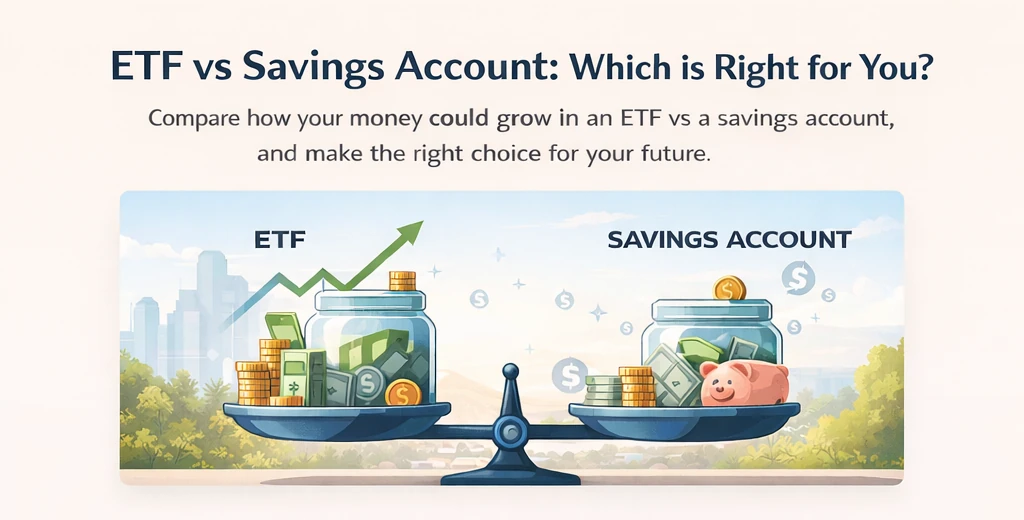
Growth chart
This chart shows your projected end‑of‑year balance using monthly compounding.
Disclosure: This page contains affiliate links. If you sign up through these links, I may earn a commission at no extra cost to you.
Want to track how your investments actually perform over time?
Read my Sharesight review
.
Track Your Investments
If you’re investing regularly, it’s important to track your actual returns, dividends, and portfolio performance.
Tools like Sharesight make it easy to see how your investments are really performing over time.
📈 Track your investments with Sharesight →
Plan Your Money Properly
If you're serious about reaching these results, a tool like Pocketsmith can help you
track your spending, plan future savings, and stay consistent.
Try Pocketsmith →
FAQ
Why might an ETF outperform a savings account?
Historically, diversified market investments have often returned more than cash savings over long periods — but they also come with volatility and risk.
Is the ETF return guaranteed?
No. ETF returns fluctuate. This calculator uses your chosen return rate as an assumption so you can compare scenarios.
Why does the gap become bigger over time?
Because compounding amplifies the difference between two rates. The longer the time horizon, the more rate differences matter.
Does this include ETF fees or taxes?
No. Fees and taxes can reduce real-world returns. Use this as a directional comparison rather than an exact forecast.
What’s a reasonable way to use this page?
Try a conservative ETF return assumption and compare multiple timelines (10, 20, 30 years). For compounding basics, see How it works →